The Third Place Renaissance: Why Local Meetups Are Replacing Your Social Feed

The Third Place Renaissance Is Here
This article was drafted with AI assistance and reviewed and edited by the Therr team before publication.
Something unexpected is happening in cities around the world. While social media companies pour billions into keeping people glued to their screens, a growing number of 20- and 30-somethings are doing the opposite — they're logging off and showing up. Run clubs are packing sidewalks. Book clubs are filling coffee shops. Neighborhood walking groups have waitlists. Searches for "social clubs" and "run clubs" have hit all-time highs in 2026, and the third place renaissance is officially underway.
If your social feed feels increasingly hollow, you're not imagining it. The people around you are quietly building something better — and it's happening in person.
What Is a Third Place (And Why Did We Lose Them)?
Sociologist Ray Oldenburg coined the term "third place" to describe the informal gathering spaces that exist between home (your first place) and work (your second place). Think neighborhood cafes, barbershops, parks, libraries, community centers — the places where you bump into familiar faces and connections happen without an agenda.
For decades, these spaces have been disappearing. Independent coffee shops gave way to drive-throughs. Community centers lost funding. Public spaces were redesigned for efficiency, not lingering. And social media promised to fill the gap — offering "connection" that could happen anywhere, anytime, from your couch.
But it didn't work. About half of all adults in the United States now report experiencing measurable levels of loneliness, according to recent research. Among young adults aged 18 to 25, that number jumps to 61%. The U.S. Surgeon General has declared loneliness a public health crisis, linking chronic isolation to depression, cardiovascular disease, and increased mortality risk.
Social media didn't replace third places. It replaced them with something that looks like connection but feels like noise.
The Local Meetup Boom
Now the pendulum is swinging back — hard. The numbers tell the story:
- IRL events are exploding. Creators, podcasters, and authors sold 500% more tickets to in-person events in 2025 compared to the previous year.
- Community clubs are surging. Interest in social clubs, run clubs, and local interest groups has reached record levels, with new groups launching in cities worldwide every week.
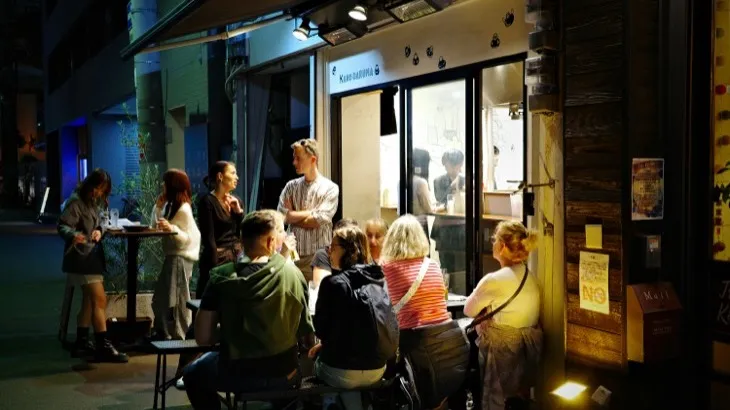
- The vibe is different. These aren't the networking events of the 2010s. Today's meetups are casual, interest-driven, and intentionally small. A morning run club. A neighborhood supper club. A book swap at a local park.
What these gatherings have in common is what social media lacks: presence. You can't half-scroll through a running club. You can't passively consume a potluck dinner. Showing up requires — and rewards — your full attention.
Why Your Social Feed Can't Compete
Here's the uncomfortable truth for platforms built on engagement metrics: the kind of connection people actually crave can't be delivered through a screen. Harvard research has consistently shown that social media use is only positive for mental health when it's used to maintain close, supportive relationships — not when it's a substitute for them.
The local meetup boom isn't anti-technology. It's a recognition that technology works best as a bridge to real-world interaction, not a replacement for it. People aren't quitting social media entirely — they're using it differently. They're searching for "running groups near me" instead of scrolling influencer content. They're joining neighborhood groups instead of following strangers.
The most powerful social technology in 2026 isn't an algorithm. It's a group chat that ends with "same time next Thursday?"
How Communities Are Addressing the Loneliness Epidemic
The loneliness epidemic isn't just a personal challenge — it's a community one. And increasingly, communities are responding with structural solutions, not just awareness campaigns. Cities are investing in public spaces designed for gathering, not just passing through. Libraries are hosting evening social events. Parks departments are partnering with local groups to program regular activities.
At the grassroots level, the response is even more creative. Neighborhood supper clubs, porch concerts, tool-lending libraries, and community fridges are all examples of residents building their own third places when formal ones don't exist. These initiatives work because they lower the barrier to connection — you don't need to sign up, pay a fee, or know anyone. You just show up.
Technology plays a supporting role too. As people develop healthier social habits, they're using apps not to replace in-person interaction but to discover it. Platforms like Therr help bridge the gap by surfacing local gatherings, events, and community spaces that you might otherwise walk right past.
How Proximity-Based Platforms Support the Renaissance
If the future of social connection is local and in-person, then the platforms that thrive will be the ones designed to get you off the app and into the world. That's the opposite of how most social networks work — but it's exactly the model that the third place renaissance demands.
Therr is built around this idea. Instead of feeding you content from around the globe, Therr surfaces what's happening near you right now — proximity-activated posts that come alive when you're in the neighborhood. A new cafe opening three blocks away. A running group meeting at the park Saturday morning. A pop-up market you'd walk right past without knowing it was there. You can browse the same ground from the web — the bars and parks listings are where most people's third place turns out to be hiding.
The goal isn't engagement for engagement's sake. It's discovery that leads to showing up. When your social platform is organized around real places and real proximity, it naturally becomes a bridge to the third places in your community.
Finding (or Building) Your Third Place
You don't need to wait for the perfect club to appear. The third place renaissance is built by the people who show up. Here's how to get started:
- Start absurdly small. Invite two people to walk and talk once a week. That's a club. The best communities grow from consistent, low-pressure gatherings — not launch events.
- Anchor it to a place. Pick a cafe, a park bench, a corner of the library. Regularity and location matter more than programming. Third places work because you know where to find them.
- Use technology as the on-ramp. Post about your gathering on a local platform like Therr. Let nearby people discover it organically. Then put the phone away and be present.
- Lower the bar for participation. No RSVPs. No membership fees. No pressure to speak or perform. The best third places are the ones you can drift in and out of naturally.
- Be a regular somewhere. Sometimes building community doesn't require organizing anything. It just means choosing the same coffee shop every Saturday, learning the barista's name, and nodding at the person who's always reading in the corner.
The Connection You're Scrolling For Already Exists Nearby
The third place renaissance isn't a rejection of the digital world. It's a correction. For years, we outsourced connection to algorithms that prioritized time-on-screen over quality of interaction. Now people are remembering what sociologists have known all along: the strongest communities are built face to face, in places you can walk to, with people who live near you.
The good news? Those places still exist. And new ones are being created every day by people who decided to stop scrolling and start showing up. And as local event discovery improves and local creators spotlight neighborhood gems, finding your third place is getting easier. The connection you've been searching for online might already be waiting at the cafe around the corner.
Have you found your third place? We'd love to hear about the local communities and meetups that are making a difference in your neighborhood. Drop us a line at info@therr.com.